
Why AI sales projects fail: 6 reasons I see in B2B sales teams
From 70+ B2B teams: the 6 reasons AI sales projects fail, from skipped foundations to no ROI tracking, plus a 10-question checklist to run before your next AI project.
 Written byVytas MikulėnasFounder, Lean Sales Systems
- Published
- Reading time
- 9 min read

TL;DR
- AI sales projects fail for 6 reasons: AI is used as the foundation, people stay the bottleneck, the team never changes how it works, nobody owns it, nobody can see the return, and companies build it alone.
- BCG's 10-20-70 rule puts 70% of the effort behind AI success on people and processes, not on algorithms or technology.
- Run the 10-question checklist at the end before you buy another AI tool.
On this page
AI sales projects fail for 6 reasons I see again and again in B2B teams. AI is used as the foundation instead of the last layer. People stay the bottleneck. The team never changes how it works. Nobody owns the project. Nobody can see the return. And the company tries to build it alone. The technology is rarely the problem. The checklist at the end shows what to fix first.
Since 2023 I have built sales automation and AI workflows with 70+ B2B teams at Lean Sales Systems. The tools changed every year. The reasons projects failed did not. When I shared the picture above on LinkedIn, it drew more sales leaders than anything I usually post.

Why do AI sales projects fail?
Most AI sales projects fail for business reasons, not technical ones. BCG's 10-20-70 rule puts 10% of the effort on algorithms, 20% on technology and data, and 70% on people and processes (BCG, 2024, source). Here are the 6 reasons I see most, and the fix for each.
| Reason | What you see | The fix |
|---|---|---|
| 1. AI is the foundation, not the last layer | AI runs on messy CRM data and an unclear process | Build the 4 steps under AI first |
| 2. People are still the bottleneck | Reps prompt a chatbot 1 account at a time | Workflows that run on triggers, without a person |
| 3. The team never changes how it works | The tool is live, but reps work the old way | Put AI inside the tools reps already use, and train them |
| 4. No focus and no owner | Several pilots, many tools, nobody responsible | 1 owner, 1 use case, 1 number, 90 days |
| 5. Nobody can see the return | Only revenue or meetings are tracked | Leading KPIs from week 1, tracked in the CRM |
| 6. Built alone, from scratch | An internal side project that never ships | A specialist partner, then a handover with training |
1. AI is used as the foundation, not the last layer
“AI is the top layer. Not the foundation.” AI is step 5 of 5. Under it sit a viable sales model, a standard process, clean sales data and automation. Skip those steps and AI targets the wrong buyers, follows no process and writes from wrong facts.

| Step | Ready when |
|---|---|
| 1. Viable sales model | You know who buys, why and at what price, proven by recent deals |
| 2. Standard process | Every rep runs the same stages, with clear rules to move a deal |
| 3. Clean sales data | 1 source of truth in the CRM, updated within a day |
| 4. Automation | Research, follow-ups and CRM updates run without a rep |
| 5. AI sales system | AI agents research, write and score inside your process |
Gartner (2025) predicts that through 2026, organizations will abandon 60% of AI projects unsupported by AI-ready data (source). For the tools behind each step, see our 20 B2B sales tools in 7 categories.
AI multiplies what is already there. On a broken process, it breaks things faster.
2. People are still the bottleneck
This is the reason I see most often. A company buys AI licences, and each rep chats with AI 1 account at a time. In my experience, some tasks get 30% to 60% faster. But the rep still has to start every task, so output barely moves.
Human attention stays the bottleneck. One of my favorite articles on this is The Attention Floor by Vlad Podoliako. His point: the bottleneck has moved to a person with a fixed number of hours.
Sellers already spend only 40% of their time selling (Salesforce, State of Sales 2026, source). Gartner warns that "layering additional prompts and tools onto already complex workflows risks overwhelming sellers" (2025, source).
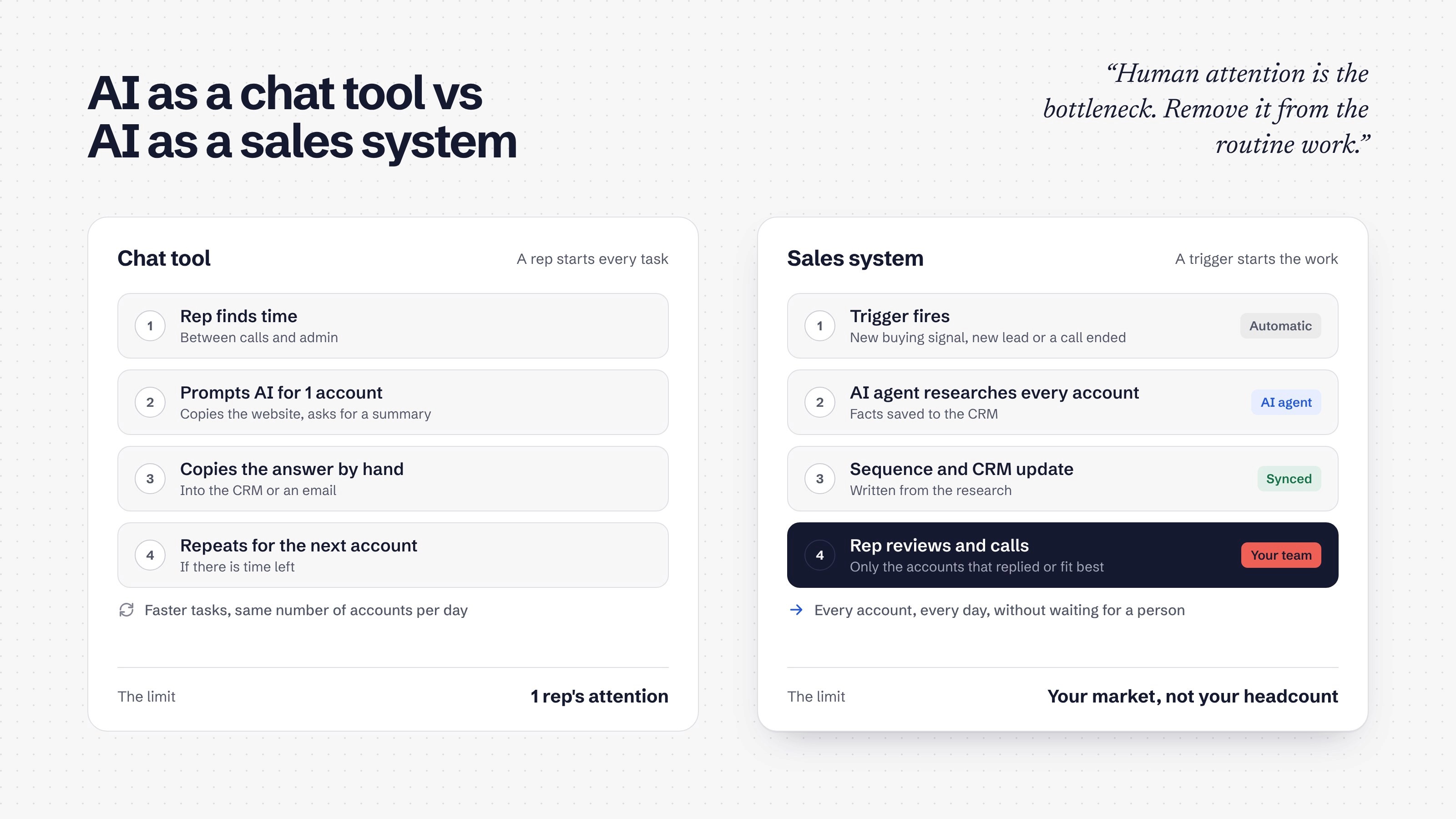
| AI as a chat tool | AI as a sales system | |
|---|---|---|
| Who starts the work | A rep, when they find time | A trigger: a buying signal, a new lead, a call that ended |
| Scale | 1 account at a time | Every account, every day |
| What the rep does | Prompts, copies and pastes | Reviews the output and calls the right accounts |
| Where the result lands | A chat window | The CRM, the sequence, the calendar |
| What you gain | Minutes saved per rep | More pipeline without more people |
The fix is to take people out of the routine loop and keep them where judgement matters: qualifying, calls and closing. For Tempus, outreach automation brought 1,200+ replies in 3.5 months with 0 extra sales team hours. At Brasta, AI research workflows cut lead research time by 95%+.
3. The team never changes how it works
The next big bucket is change management. Even the best workflow fails if it adds a step to a busy rep's day. Reps who carry a quota protect their time. If AI output sits in a separate tool, needs another login or feels unreliable, they quietly go back to the old way.
The gap is wide. Gartner predicts that by 2028 AI agents will outnumber human sellers 10 to 1, yet fewer than 40% of sellers will say agents improved their productivity (2025, source).
What works in our projects:
- Put AI output where reps already work: the CRM, the inbox, the calendar.
- Remove 1 manual task for every new task you add.
- Train the team on their own accounts, not on a demo.
- Show 1 win every week: replies, meetings or hours saved.
- Make 1 sales leader the visible sponsor.
Analote combined outreach automation with sales team training. Their 7-person team doubled new business in Western Europe.
4. No focus and no owner
AI projects die as side projects. The sales team is busy hitting this month's number. Marketing tests 1 tool, sales tests another, and nobody owns the result. 51% of sales leaders with AI say disconnected systems are slowing down their AI initiatives (Salesforce, State of Sales 2026, source).
My rule for a first project: 1 owner, 1 use case, 1 number, 90 days. Good first use cases are account research, follow-ups on positive replies and CRM updates after calls. Each one is frequent, easy to measure and tedious to do by hand.
The owner needs real time in their week. "Everyone does a bit" means nobody does it.
5. Nobody can see the return
Even when AI saves time, the CEO eventually asks what the company got for it. Without numbers, the budget goes. Gartner predicted that at least 30% of generative AI projects would be abandoned after proof of concept by the end of 2025, with unclear business value among the reasons (2024, source).
Long B2B sales cycles make this worse. If a deal takes 6 months to close, revenue arrives too late to judge the project. Counting only meetings misses every prospect who said "not now" but may buy next year. Track the whole funnel from week 1:
| When | Track | What it proves |
|---|---|---|
| Weeks 1 to 4 | Replies, positive replies, hours saved per rep | The system runs |
| Months 1 to 3 | Interested leads (MQLs), sales-qualified leads (SQLs), meetings held | The pipeline is real |
| Months 3 to 12 | Pipeline value, win rate, revenue from new clients | The return |
| Always | "Not now" leads with a follow-up date | Long-cycle deals do not leak |
The quick test
Can you say how much revenue came from new clients last quarter, and from which channel? If not, no AI tool, agency or hire can be proven to work. For reference, our first-quarter client averages are 40,000 touchpoints, 10,000 decision makers, 1,000 replies, 200 interested leads and 8 to 36 closed deals. Revenue is only the last line of that funnel.
6. Built alone, from scratch
Many companies hand AI to an internal enthusiast as a side project. It rarely ships. MIT's NANDA research found that buying from specialized vendors and partnering succeeded about 67% of the time, while internal builds succeeded about a third as often (2025, source).
In-house can work if you have a full-time owner with sales operations skills. Most €1M to €100M B2B companies do not, and that is fine. The system can be built with a partner and handed over with training, so your team owns it.
Checklist: 10 questions before your next AI sales project
Ask your team these questions. 2 or more red-flag answers mean you should fix those first, before you buy another AI tool.
| Ask your team | Red-flag answer | What breaks |
|---|---|---|
| Who is our best customer, and which recent deals prove it? | "Anyone who needs our product" | AI finds the wrong buyers faster |
| Is every deal and contact in 1 CRM? | "Mostly, some live in Excel" | AI writes from wrong facts |
| Which AI task runs without a person starting it? | "None, reps use a chatbot" | Minutes saved, no new pipeline |
| Where does AI output land for a rep? | "In a separate tool" | Reps fall back to old habits |
| Was the team trained on its own accounts? | "We shared a video" | Low trust, low use |
| Who owns the project, and how much of their week goes to it? | "Everyone does a bit" | It stays a side project |
| What is the 1 use case for the next 90 days? | "We are testing a few things" | Nothing reaches daily work |
| Which KPI proves it works in month 1? | "Revenue" | No proof before the budget review |
| Do we track "not now" leads with a follow-up date? | "No" | Long-cycle pipeline leaks |
| Who has built this before? | "Our IT team will figure it out" | A pilot that never ships |
Want a second opinion? Book a 30-minute call with Vytas and bring your answers.
Most companies treat this as a tool problem, so they buy another AI licence. It is a system problem: AI needs foundations under it, workflows that run without people, a team that uses it and numbers that prove it. Lean Sales Systems builds that system around the CRM you already have, then runs it or trains your team to own it.
FAQ
How do you measure the ROI of AI in sales?
Track leading indicators from week 1, not only revenue. Start with replies, positive replies and hours saved. Then interested leads, sales-qualified leads and meetings. Then pipeline value, win rate and new-client revenue. In long sales cycles, also track "not now" leads with a follow-up date, because they become next year's deals.
How do you get sales reps to use AI?
Make it easier than the old way. Put AI output inside the CRM and inbox reps already use, remove a manual task for each new one, and train the team on their own accounts. Show a small win every week. If reps must open a separate tool and prompt it themselves, adoption stays low.
Does CRM data need to be clean before using AI?
Yes, for any AI that writes, scores or forecasts from your data, because AI repeats what the CRM says. You do not need perfect data. You need 1 source of truth that reps update within a day, with required fields for deal source, stage and lost reason.
Should we build AI sales automation in-house or with a partner?
Build in-house only if you have a full-time owner with sales operations skills. MIT's 2025 research found that partnerships succeeded about 3 times as often as internal builds. Lean Sales Systems builds the system with your team and trains them to own it, so you are not locked in.
Bottom line
AI sales projects rarely fail because of the model. They fail because of the system around it: the foundations, the people, the focus and the proof. Fix those first, and AI becomes the easy part.


