
B2B Sales Strategy 2026: Why Old Playbooks Fail and What Replaces Them
Why traditional B2B playbooks stop working and what replaces them: intent-driven outbound, systems and AI used where it fits.
 Written byVytas MikulėnasFounder, Lean Sales Systems
- Published
- Reading time
- 5 min read

TL;DR
- Cold outbound response rates have dropped by over 40% compared to five years ago.
- Buyers complete over 60% of their journey before speaking to sales, so signals and timing matter.
- One Baltic IT services company cut outbound volume by 35% while doubling booked meetings.
On this page
If B2B sales feels harder than it used to, you’re not imagining it.
Many teams are still using playbooks designed 8–10 years ago.
Meanwhile, buyer behavior, technology, and competition have moved on.
That gap is the core problem behind B2B sales strategy 2026.
In this article, we’ll break down why traditional sales approaches fail today.
We’ll also cover what has changed in B2B buying and what replaces the old playbook.
This is not theory.
It’s practical guidance for teams that need results, not buzzwords.

Why Traditional B2B Sales Playbooks Fail in 2026
Most classic B2B sales playbooks were built for a simpler time.
There were fewer channels, less noise, and far less data.
Today, those assumptions no longer hold.
Email inboxes are saturated, and LinkedIn outreach feels repetitive.
Cold calls rarely reach decision-makers anymore.
According to industry data, cold outbound response rates have dropped by over 40% compared to five years ago.
The tactic didn’t suddenly “die.”
It just stopped working at scale.
Another issue is structural.
Many playbooks treat sales as an isolated function.
Marketing generates leads.
Sales closes them.
Operations cleans up later.
In reality, modern growth doesn’t work in silos.
When systems don’t talk to each other, teams lose time and trust.
This is where frustration sets in.
More activity, but the same results.
The 3 Most Common Outdated B2B Sales Tactics
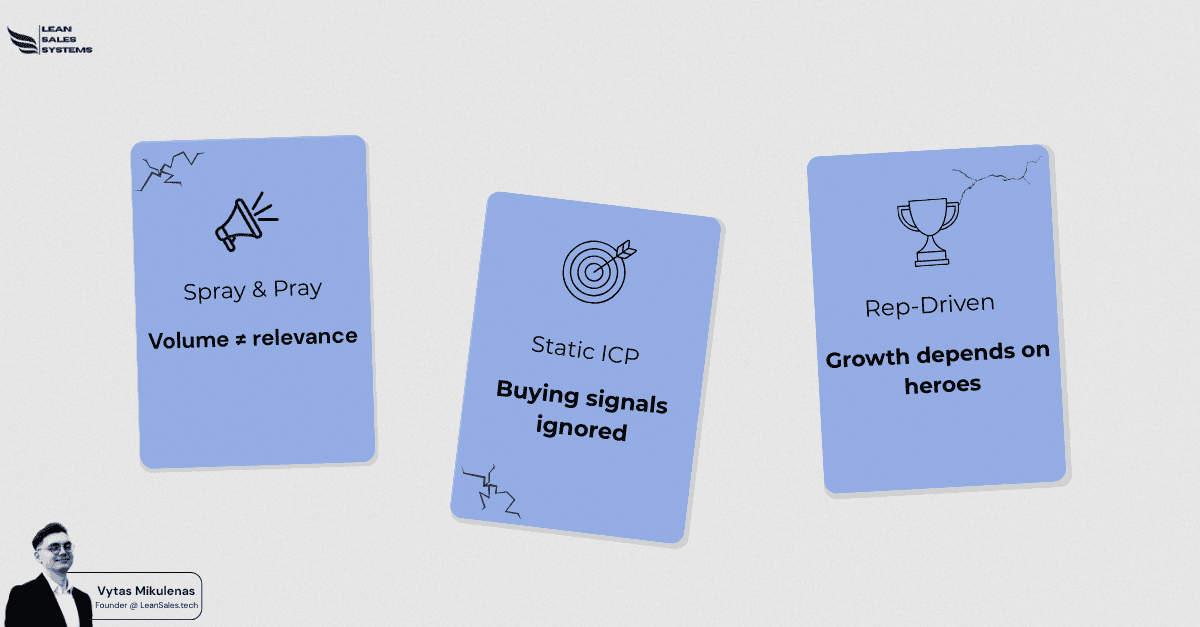
The first is spray-and-pray outbound.
Large lead lists and generic messages rely on volume to compensate for relevance.
Buyers spot irrelevant outreach instantly.
Response rates suffer as a result.
The second is static ICPs.
Many teams define an ideal customer once and never revisit it.
In 2026, good ICPs are dynamic.
They change based on timing, signals, and buying intent.
The third is rep-driven sales.
When results depend on individual heroes, growth becomes fragile.
When those people leave, pipeline often leaves with them.
This risk is common in founder-led sales teams.
A Lithuanian SaaS founder we worked with faced exactly this issue.
Growth stalled not because demand disappeared, but because knowledge lived in people’s heads instead of systems.
What’s Changed in B2B Buying Behavior
Modern buyers behave very differently than they did a decade ago.
Most B2B decision-makers now complete over 60% of their buying journey before speaking to sales.
They research quietly.
They compare vendors.
They ask peers for recommendations.
This creates a visibility problem for sellers.
From the outside, it looks like demand appears suddenly.
In reality, the signals were there all along.
They simply weren’t tracked or connected.
Another major shift is the rise of buying committees.
Deals now involve more stakeholders with different priorities.
One message rarely fits all.
Personalization is no longer optional—it’s expected.
These changes force a rethink of B2B sales strategy 2026.
Selling is no longer about pushing harder.
It’s about showing up at the right moment, with the right context.

How to Stop Your Automated Emails from Sounding Like Spam
B2B Sales Strategy 2026: From Tactics to Systems
The biggest shift in B2B sales strategy 2026 is simple but powerful.
Tactics matter less than systems.
A system connects signals, data, actions, and feedback.
It doesn’t rely on memory or manual effort.
Most importantly, it improves over time.
This creates compounding results instead of linear effort.
In practice, this starts with identifying intent signals.
Examples include website visits, job changes, tech stack updates, or content engagement.
Next, those signals are enriched with context.
Only then does outreach happen.
Teams using this approach see better results with fewer activities.
One Baltic IT services company reduced outbound volume by 35% while doubling booked meetings.
Systems turn chaos into leverage.
The New B2B Sales Operating Model
The modern operating model blends sales, marketing, and operations.
Instead of arguing over lead quality, teams align around shared data.
Micro-ICPs replace broad personas.
Outreach adapts to timing, not just company size or industry.
Automation handles repetitive tasks.
Humans focus on conversations, positioning, and trust.
This model doesn’t remove salespeople.
It makes them far more effective.
How AI Actually Fits Into B2B Sales (And Where It Doesn’t)
AI is a major enabler of B2B sales strategy 2026.
But it is often misunderstood.
AI works best when it replaces tasks, not judgment.
Research, enrichment, lead scoring, follow-ups, and CRM updates are ideal use cases.
These tasks consume time but don’t require creativity.
In many cases, AI performs them for a fraction of the cost.
However, AI does not replace trust.
It doesn’t handle objections well.
It also struggles with nuance without guidance.
This is why “just using ChatGPT” rarely changes results.
Think of AI as leverage.
Not a shortcut.
A Proven Guide to Unlocking Growth
Sales Tasks AI Can Handle for ~1% of the Cost
AI excels at data-heavy work.
Prospect research that once took 20 minutes can now happen in seconds.
Follow-ups no longer depend on human memory.
CRM hygiene improves automatically.
This matters because time is the most expensive resource in sales.
Reducing low-value work creates immediate ROI.
What Replaces the Old Playbook in 2026
So what actually replaces the old playbook?
First, intent-driven outbound.
Teams prioritize accounts already showing buying signals instead of guessing.
Second, automated meeting generation.
Calendars fill through systems, not hustle. Sales teams spend more time speaking with serious buyers instead of chasing cold prospects.
Third, continuous optimization.
Messaging, ICPs, and workflows evolve based on real data. When something underperforms, they adjust quickly instead of defending outdated assumptions.
We’ve seen this shift in practice with Baltic B2B companies targeting Nordic markets. Instead of increasing headcount, teams improved targeting precision and automated early-stage qualification. The result was a higher volume of qualified conversations without expanding the sales team.
This is the core of B2B sales strategy 2026.
How to Start Implementing a 2026-Ready B2B Sales Strategy
You don’t need to rebuild everything at once.
Start with an audit.
Identify where manual work slows your team down.
Look for bottlenecks, not tools.
Next, redefine your ICP using real signals.
Focus on who buys fastest and converts best.
Then design one automated workflow that removes friction.
Start small and expand.
Finally, measure outcomes.
Track meetings booked, sales cycle length, and cost per opportunity.
Progress beats perfection.
Final Thoughts: Adapt or Be Outperformed
B2B sales strategy 2026 rewards teams that adapt early and test often.
AI is no longer optional, but it is not magic.
The advantage goes to teams that implement thoughtfully.
If your team still relies on old playbooks, the gap will grow.
If you want help designing or implementing a modern B2B sales system, we can help.
Book a sales system audit and uncover where leverage is hiding in your process.


