
Founder Led Sales Problems: 7 Reasons Growth Stalls
Seven founder led sales problems that stall growth, and the five steps to move to a scalable sales system.
 Written byVytas MikulėnasFounder, Lean Sales Systems
- Published
- Reading time
- 6 min read

TL;DR
- Many B2B companies in Lithuania and the Baltics hit the wall between €500K and €2M in revenue.
- Nearly 50% of sales hires fail within the first year, usually because the system is missing.
- Move to a scalable system in five steps: extract the process, build a framework, add tools, hire, step back.
On this page
If your revenue depends on you showing up to every sales call, you don’t have a sales system.
You might have a bottleneck.
Founder led sales problems start to show up the moment your company tries to grow beyond you.
What once worked—your network, your intuition, your personal pitch—becomes the very thing holding you back.
Many B2B companies in Lithuania and the Baltics hit this wall between €500K and €2M in revenue. Growth slows. Sales become unpredictable. Hiring doesn’t fix it.
And the issue is structure, commonly mistaken with effect.
In this article, you’ll see why founder led sales problems happen, how they limit growth, and what a scalable sales system actually looks like.
What Are Founder Led Sales Problems?
Founder-led sales means the founder drives most of the revenue. In early stages, this works well because you know the product best and move fast.
You close deals through trust and direct relationships.
But problems begin when growth depends on you staying involved in every deal. This creates dependency that limits scalability.
Founder led sales problems are not about poor sales skills. They are about lack of systems that allow others to replicate success.
According to B2B growth studies, over 70% of early-stage companies rely on founders for sales. However, fewer than 20% successfully transition to scalable systems.
In the Baltic market, this pattern is even stronger. Many companies grow through referrals and relationships, which work locally but fail to scale internationally.

7 Common Founder Led Sales Problems That Block Growth
These are the most common issues that prevent B2B companies from scaling. If you recognize more than two, your growth is already constrained.
1. You Are the Bottleneck in Sales
You handle most sales calls, negotiations, and closing. This creates a hidden ceiling on growth.
When you shift focus to operations or hiring, sales activity drops. The pipeline slows almost immediately.
For example, a Lithuanian SaaS founder paused sales for two months to focus on hiring. Pipeline dropped by over 40% during that time.
This is not a performance issue — it’s a system issue.
2. No Predictable B2B Sales Pipeline
Most deals come from referrals or inbound leads. Some months perform well, while others fall short.
Without a structured pipeline, forecasting becomes unreliable. This creates constant pressure on revenue targets.
Research shows that companies with defined sales processes achieve up to 33% higher revenue growth.
However, I have shared some analysis on why building a predictable B2B sales pipeline is difficult for many Baltic companies and what moves can help:
3. Sales Knowledge Lives Only in Your Head
You understand what works, but your team does not. There is no documented process or consistent messaging.
Without clear ICP or sales structure, knowledge stays informal. This makes it difficult to scale performance.
New hires try to replicate your approach but fail. They lack the context and experience you have built over time.
4. Sales Hires Underperform or Fail
Hiring alone does not solve founder led sales problems. Even strong salespeople fail without structure.
Common issues include:
- No onboarding process
- No defined sales stages
- No clear outreach strategy
Nearly 50% of sales hires fail within the first year. In most cases, the system — not the person — is the issue.
5. CRM and Tools Don’t Deliver Results
You may already use tools like HubSpot or Pipedrive. But results remain inconsistent.
This happens because tools are implemented without a clear process. CRM becomes a reporting tool instead of a growth engine.
Many Baltic companies adopt tools quickly but struggle with proper implementation.
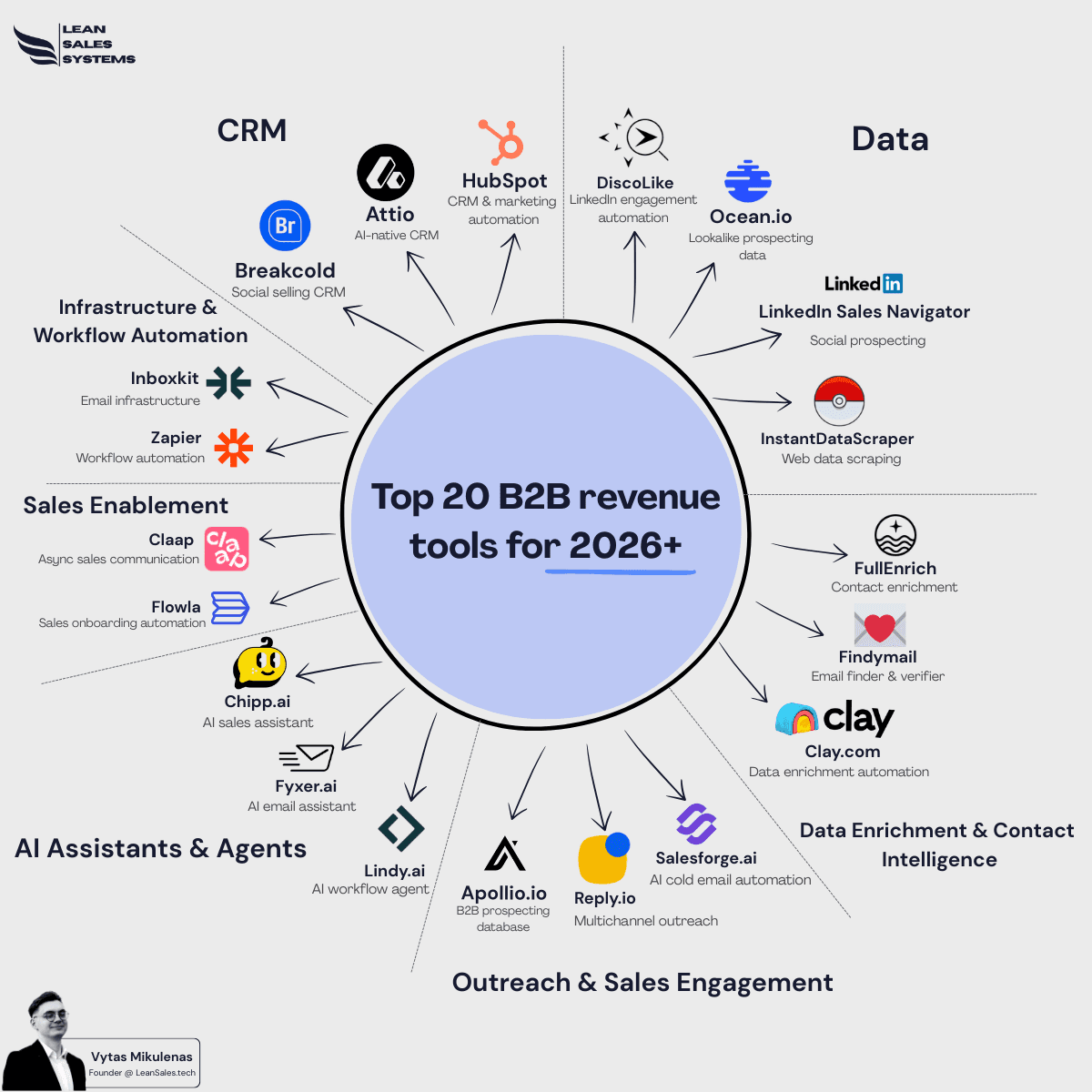
If you are wondering what actually works in practice — here is our tool stack that helps us grow:
6. Expansion to New Markets Fails
Sales strategies that work locally often fail abroad. Messaging does not resonate in markets like Sweden or Germany.
For example, a Lithuanian logistics company used the same outreach approach in Sweden. Response rates dropped below 5%.
Without localized messaging and structured outreach, expansion becomes difficult.
7. Growth Hits a Revenue Ceiling
At some point, growth slows regardless of effort. Revenue becomes tied to your personal capacity.
You can only manage a limited number of deals at once. This creates a natural ceiling.
Founder led sales problems turn into a long-term business risk if not addressed.

Why Founder-Led Sales Doesn’t Scale in B2B
Founder-led sales depends on individual performance. Scalable sales depends on systems.
This is the key difference.
In a scalable system:
- Leads are generated consistently
- Messaging is standardized
- Performance is measurable
In founder-led sales, results depend on one person.
According to McKinsey, companies with structured sales processes improve productivity by up to 20%.
The goal is not to remove the founder, but to replace dependency with repeatability.

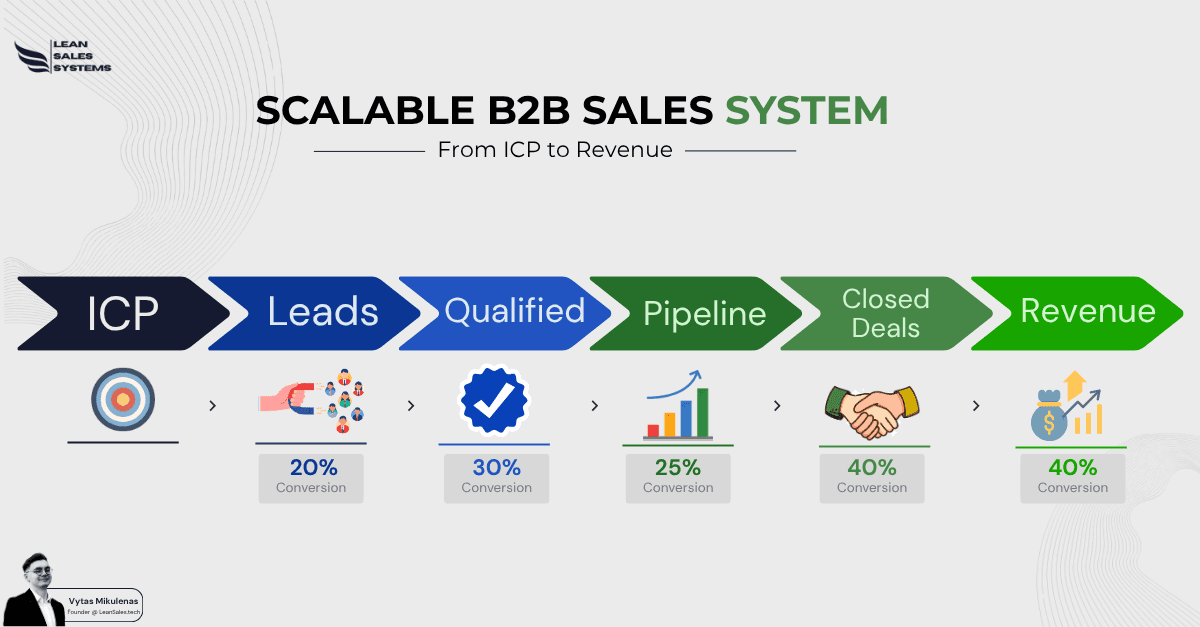
What a Scalable Sales System Actually Looks Like
A scalable system organizes sales into repeatable components. It allows consistent execution across the team.
Defined ICP and Targeting
You clearly define your ideal customer profile. This includes company size, industry, and buying triggers.
This is especially important for Baltic companies expanding internationally. Nordic markets require different positioning.
Standardized Messaging and Offer
Your value proposition is clear and repeatable. Every team member communicates the same core message.
This improves consistency and conversion rates.
Repeatable Lead Generation System
You combine outbound and inbound channels. You do not rely only on referrals.
Channels like LinkedIn, email, and content work together to generate demand.
Companies with structured lead generation often achieve 2–3x more consistent pipeline growth.
Structured Sales Process and CRM
Your pipeline stages are clearly defined. Each stage has measurable conversion metrics.
Automation supports the process but does not replace it.
Performance Tracking and Forecasting
You track key metrics such as:
- Conversion rates
- Pipeline value
- Deal velocity
This enables accurate forecasting and better decision-making.
How to Transition from Founder-Led Sales to a Scalable System
This transition requires a structured approach. It cannot be solved by tools alone.
Step 1 – Extract the Founder’s Sales Process
Document how deals are closed. Identify patterns in messaging, objections, and decision triggers.
This converts intuition into a repeatable structure.
Step 2 – Build a Repeatable Sales Framework
Define your sales stages and outreach process. Standardize messaging and workflows.
This becomes the foundation for your team.
Step 3 – Implement Tools and Automation
Only introduce tools after the process is clear. CRM and automation should support the system.
Once the process is in place, tools and automation start to make sense.
But this is where many teams go wrong…
They treat automation (and now AI) as a quick fix instead of part of a long-term system.
I recently shared a breakdown of this shift in B2B thinking, and why companies that approach AI as a short-term experiment fall behind:

How B2B teams are rethinking AI as a growth system
Step 4 – Hire and Train Against the System
Hire people who can execute structured processes. Provide clear onboarding and guidance.
This reduces ramp-up time and improves performance.
Step 5 – Gradually Remove Founder from Sales
Start by stepping back from early-stage conversations. Transition closing responsibilities over time.
The founder shifts from execution to oversight.

Founder-Led vs Scalable Sales Systems (Quick Comparison)
Founder-led sales is fast but fragile. Scalable systems take time but provide long-term stability.
In a scalable system:
- Revenue is predictable
- Hiring becomes easier
- Expansion becomes realistic
In founder-led sales:
- Growth depends on the founder
- Risk is higher
- Scaling is limited
Is Your Sales System Scalable? (Quick Self-Assessment)
Ask yourself the following:
- Can someone else close deals without you?
- Do you have a consistent pipeline every month?
- Is your CRM accurate and up to date?
If the answer is “no” to most, you are still operating in founder-led sales.
That is normal—but it signals the need for change.
Final Thoughts: Founder-Led Sales Is a Phase, Not a Strategy
Founder-led sales is necessary in early stages. It helps build traction and close initial deals.
However, staying in this phase too long limits growth.
The companies that scale successfully move from individual performance to structured systems. They build repeatability and remove dependency.
Ready to Fix Founder Led Sales Problems?
We help B2B companies in Lithuania and the Baltics:
- Build predictable sales pipelines
- Implement scalable sales systems
- Align sales, marketing, automation, and AI
If you want to move beyond founder dependency and build sustainable growth, let’s talk.


