Personalizing B2B Automation for Stronger Engagement
If you are researching how to personalize B2B automation, you already believe in automation.
You just don’t want your company to sound like spam, and that fear is valid.
Many B2B teams automate outreach and see reply rates drop below 2%.
Industry benchmarks show average cold email reply rates typically sit between 1–5%, depending on targeting and industry.
Read more. Industry benchmarks
Automation itself isn’t the issue.
The real problem is weak strategy.
In 2026, the shift is simple but important.
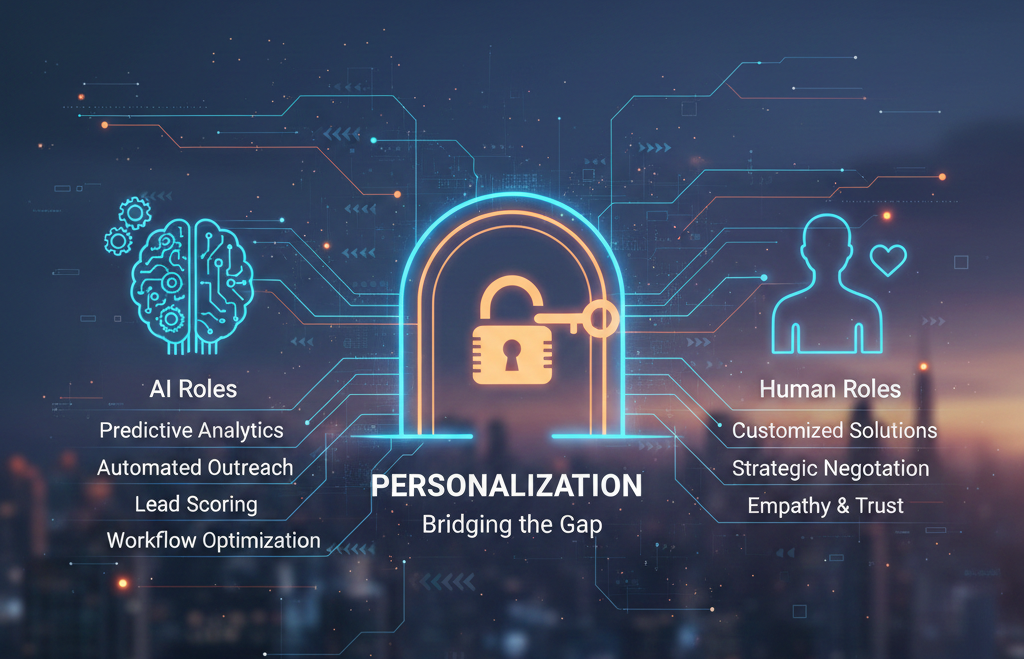
AI can research accounts, monitor signals, draft messages, and manage outreach all day and night.
Humans still work limited hours and need to focus their time carefully.
The companies that are winning aren’t arguing about AI vs people.
They’re dividing the work properly.
Repetitive, mechanical tasks are handled by AI.
Critical thinking, conversations, and relationship-building stay human.
When that split is clear, automation stops feeling robotic and starts becoming useful.
In this guide, I’ll walk through how to personalize B2B automation in a way that actually improves reply rates, protects trust with prospects, and scales without damaging your brand.
Why Most B2B Sales Automation Sounds Robotic
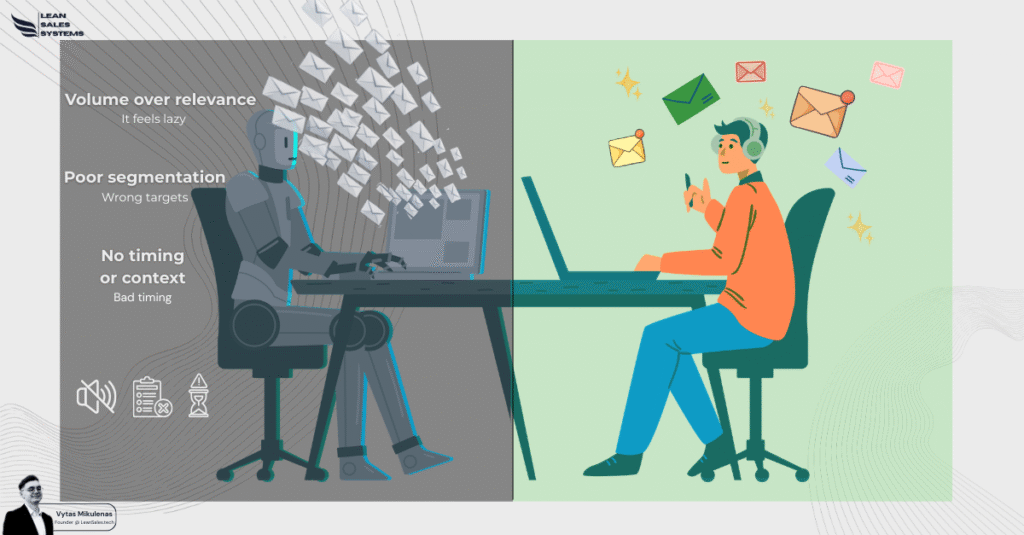
Most automation fails because it prioritizes volume over relevance.
Teams send large campaigns with small tweaks like {FirstName}.
Sadly buyers spot that instantly.
It feels lazy, automated.
And when outreach feels automated, prospects disengage.
Research from major sales engagement platforms consistently shows that contextual outreach outperforms generic campaigns
by noticeable double-digit margins.
However, relevance matters more than volume.
If your brand becomes associated with spammy outreach, you feel it fast.
Another major issue is poor segmentation.
A Lithuanian manufacturing exporter might send identical messaging to SaaS companies and logistics firms.
The value proposition becomes vague.
The message loses power.
Finally, most automation lacks timing.
There is no link to hiring, expansion, funding, or market shifts.
Without context, even a well-written message feels robotic.
If this sounds familiar, you are not alone.
The good news?
Automation can feel human when built correctly.
What Personalization in B2B Automation Actually Means in 2026
Before you improve execution, you must redefine personalization.
Personalization does not mean researching every prospect for 15 minutes.
That does not scale. It also burns out your team.
Personalization today means using AI and data to remove robotic work.
So humans can focus on real conversations.
Here’s the shift I see across Baltic revenue teams:
AI handles the repetitive work.
Humans handle decision-making and relationship-building.
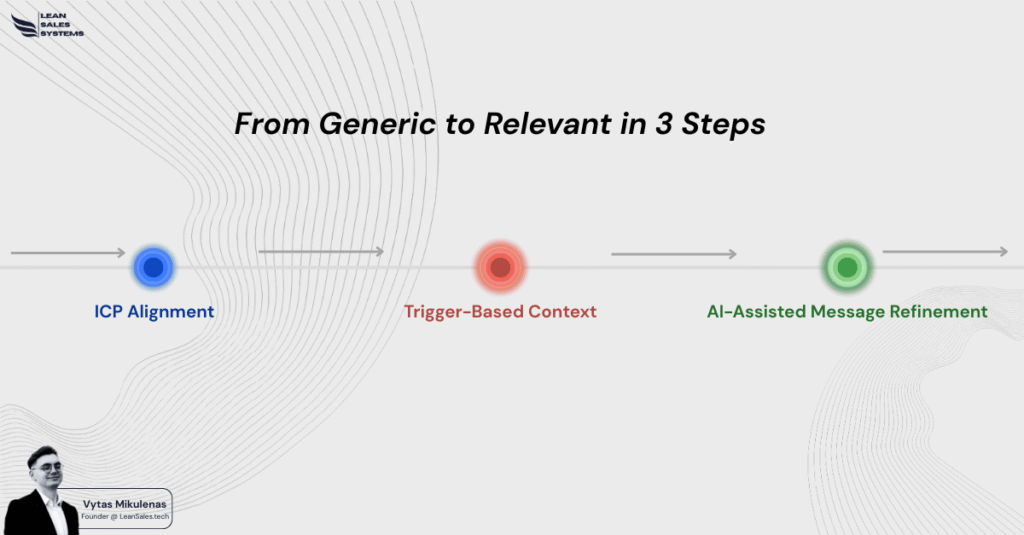
Let’s break this into three layers.
1. ICP Alignment
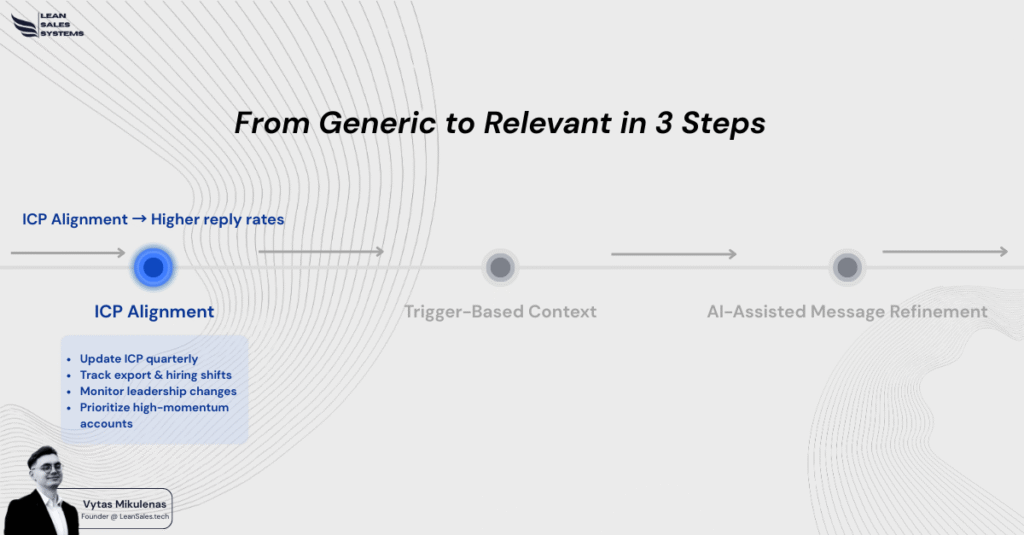
Your automation should begin with a dynamic Ideal Customer Profile (ICP).
Old contact lists from two years ago won’t hold up anymore. Markets shift. Export patterns change. Decision-makers move between companies.
For example, many Baltic manufacturers have recently increased exports to Scandinavia. If that trend is visible in your market, it should directly influence your targeting.
When your ICP becomes clearer, several things improve quickly: reply rates rise, messaging becomes sharper, and sales cycles usually shorten.
A well-defined ICP reduces wasted outreach and protects your brand from irrelevant messaging.
2. Trigger-Based Context
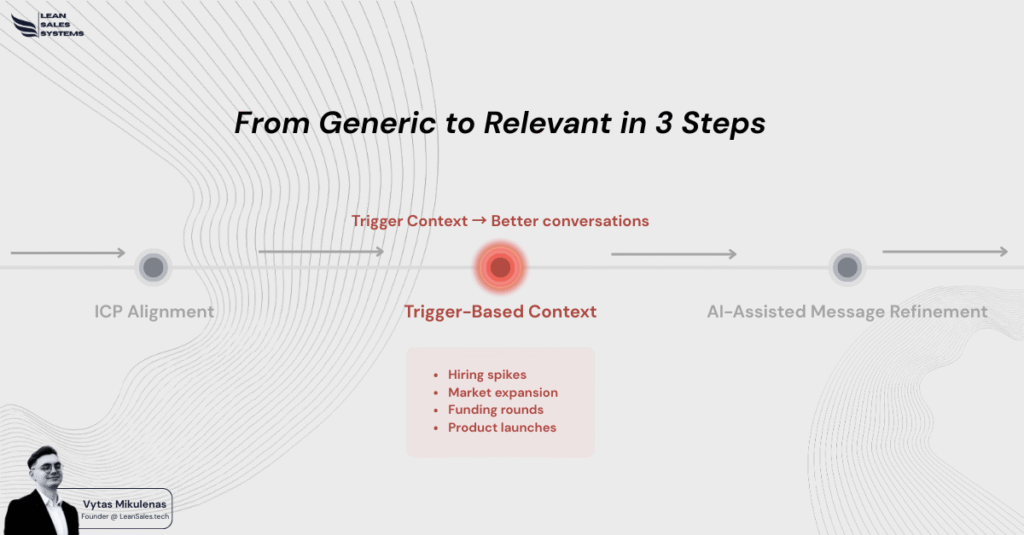
Companies are far more likely to respond when outreach connects to a real business moment.
Hiring a new executive, expanding into another market, or launching a product often signals that priorities are changing. Outreach aligned with these triggers consistently performs better than generic campaigns.
Take a simple example. If a Lithuanian SaaS company starts expanding into Germany, that context immediately gives your message relevance.
Instead of writing something vague like:
“We help companies grow.”
You can say:
“We noticed your expansion into Germany and help teams manage cross-border sales complexity.”
That single detail changes the tone of the conversation.
It feels informed rather than robotic.
3. AI-Assisted Message Refinement
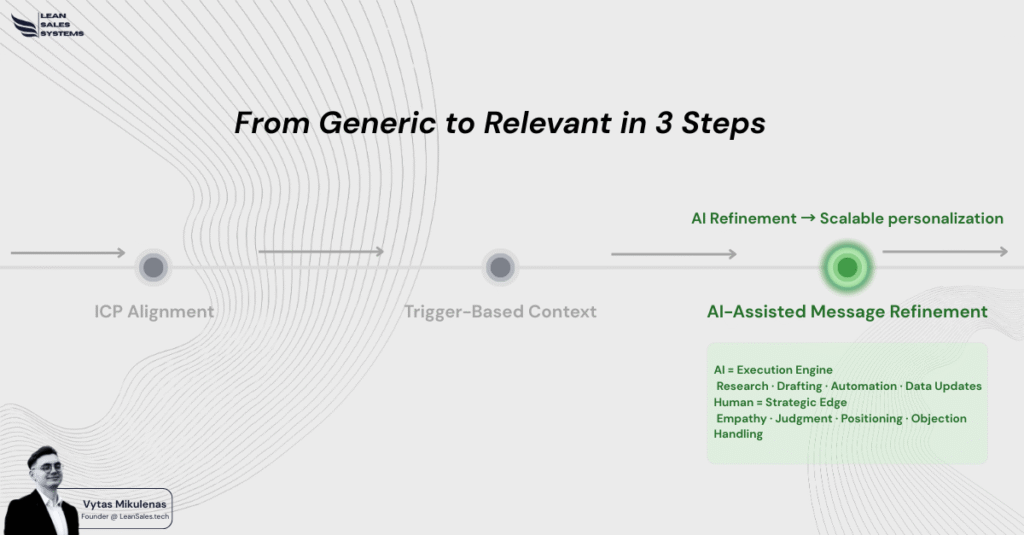
AI should eliminate robotic work.
Robotic work includes:
- Data enrichment
- Tier 1 support replies
- Manual CRM updates
- First-draft email writing
- Copy-pasting messages
Humans usually find this work draining, but AI handles it effortlessly.
Inside Lean Sales Systems, I use AI to research accounts, summarize websites, create first drafts, automate LinkedIn sequences, take meeting notes, and fill CRM fields.
But people still do the work that matters most:
Adjust tone
Protect brand voice
Ask better questions
Say “no” to bad-fit leads
Make prospects feel understood
AI becomes the 24/7 engine behind the process.
Humans remain the 9–5 strategic edge.
That balance is what keeps B2B automation effective without losing authenticity.
How to Personalize B2B Automation Step-by-Step
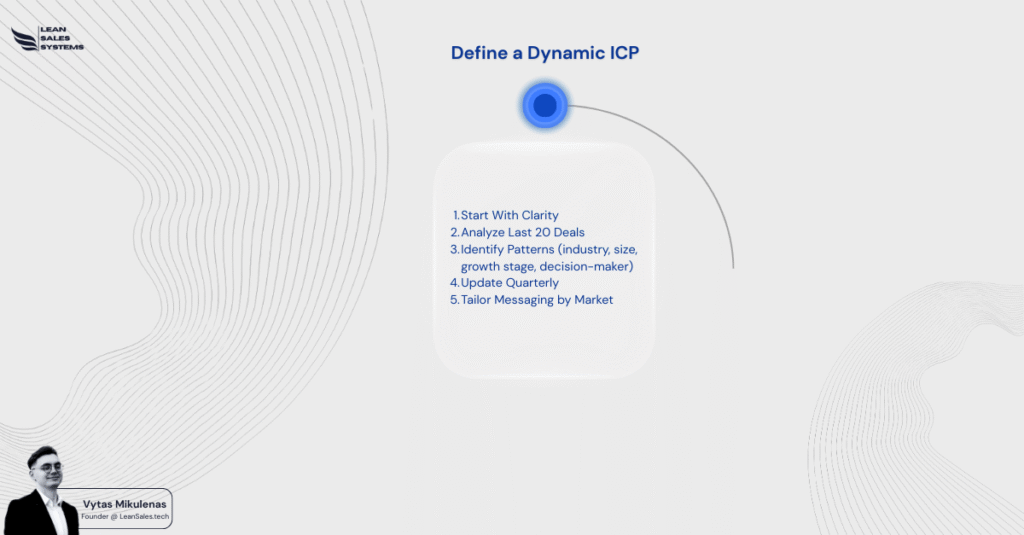
Step 1 – Define a Dynamic ICP Before Automating
Automation should never start with a tool.
It starts with clarity.
Start by reviewing your last twenty closed deals. Look for patterns in industry, company size, export markets, growth stage, and the role of the decision-maker.
Those patterns form your baseline ICP.
But it shouldn’t stay static. Revisit it at least every quarter.
Markets evolve quickly. For instance, Baltic companies expanding into Nordic markets often require different messaging than businesses focused only on local clients.
A well-defined ICP reduces wasted outreach and protects your brand from irrelevant messaging.
Step 2 – Use Triggers Instead of Manual Research
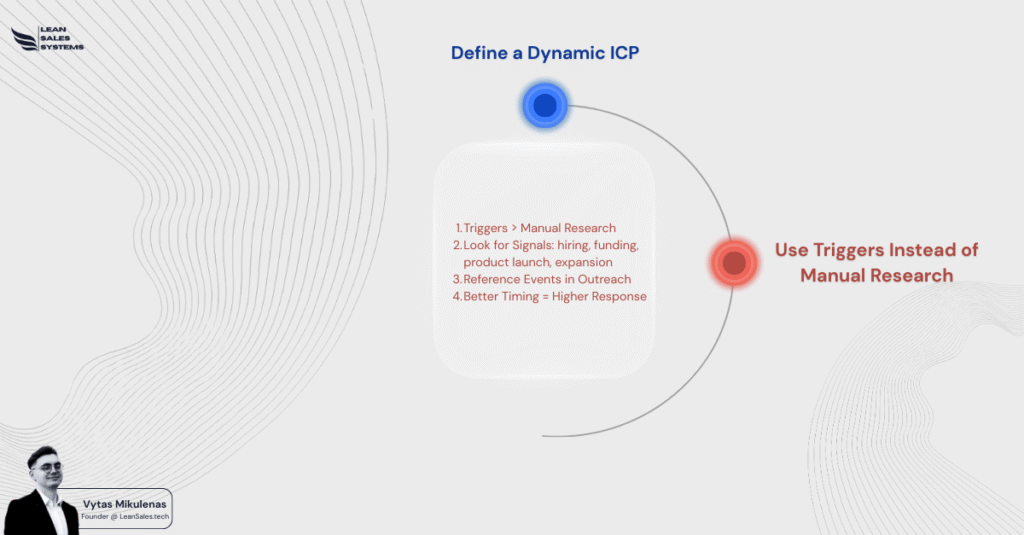
Manual personalization does not scale.
Triggers scale.
So why do most teams still ignore them?
Hiring announcements, funding rounds, product launches, or expansion into Sweden or Denmark are strong conversation starters.
For example, if a Lithuanian engineering firm hires a Nordic Sales Director, that signals growth.
Your outreach can reference that expansion directly.
Timing increases response probability.
This improves meeting quality and pipeline efficiency.
Step 3 – Let AI Remove Repetitive Work
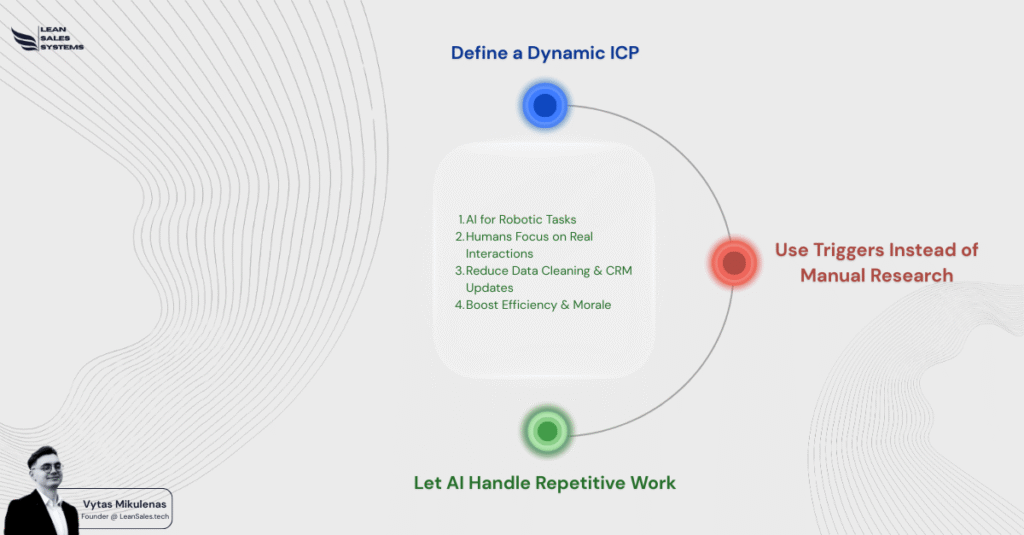
Sales teams shouldn’t compete with AI on repetitive tasks.
And AI shouldn’t replace humans where genuine interaction matters.
When sales reps spend hours cleaning data, copying messages, or updating CRM records, the entire revenue team slows down. Costs rise, morale drops, and productivity suffers.
A better approach is letting AI take care of repetitive work, such as:
- First drafts
- Data enrichment
- Account research
- Meeting summaries
- Follow-up reminders
Read more on Vytas Mikulenas Linkedin
Then let humans focus on trust and qualification.
This division of labor is what makes automation feel human.
What You Should Never Automate in B2B Sales
In 2025, my mindset went too far.
I was robotic in business and life, I wasted time on systemizing the wrong things.
And I forgot key human pieces:
- Do not automate negotiation.
- Do not automate objection handling.
- Do not automate closing conversations.
Some parts must stay human.
In high-value B2B deals, relationships drive decisions.
Studies consistently show personalized follow-ups increase close rates significantly compared to automated sequences.
In Lithuania and neighboring markets, trust compounds over time.
Automation should start conversations.
Humans should close them.
A simple rule works well:
- Automate awareness
- Humanize conversion

The hard truth I saw after a two-week break. Linkedin post
How to Measure If Your Automation Feels Human
You cannot improve what you do not measure.
Start with reply rate.
But also measure positive replies, meeting bookings, and conversation depth.
If automation feels robotic, responses are short.
“Not interested.”
“Remove me.”
If it feels relevant, prospects ask follow-up questions.
In B2B outbound, 3–5% reply rates are common benchmarks.
Highly targeted campaigns can exceed that range.
Build a simple dashboard.
Compare contextual messaging versus generic templates.
Over time, patterns will emerge.
Final Thoughts: Automation Should Amplify Humans, Not Replace Them
The question is not whether to automate.
The question is how to personalize B2B automation without damaging trust.
AI should remove robotic work.
Humans should handle meaning, nuance, and decision-making.
If your 2026 goal is similar to mine — no more robotic work in sales, marketing, or support — start small.
Pick one repetitive task.
Ask AI to help you find tools. Then test, improve, improve again, and just then – scale.
Growth should feel strategic.
